Understanding the EU acquis, legislative transposition, and why language infrastructure is becoming essential for Ukraine's European integration and business compliance.
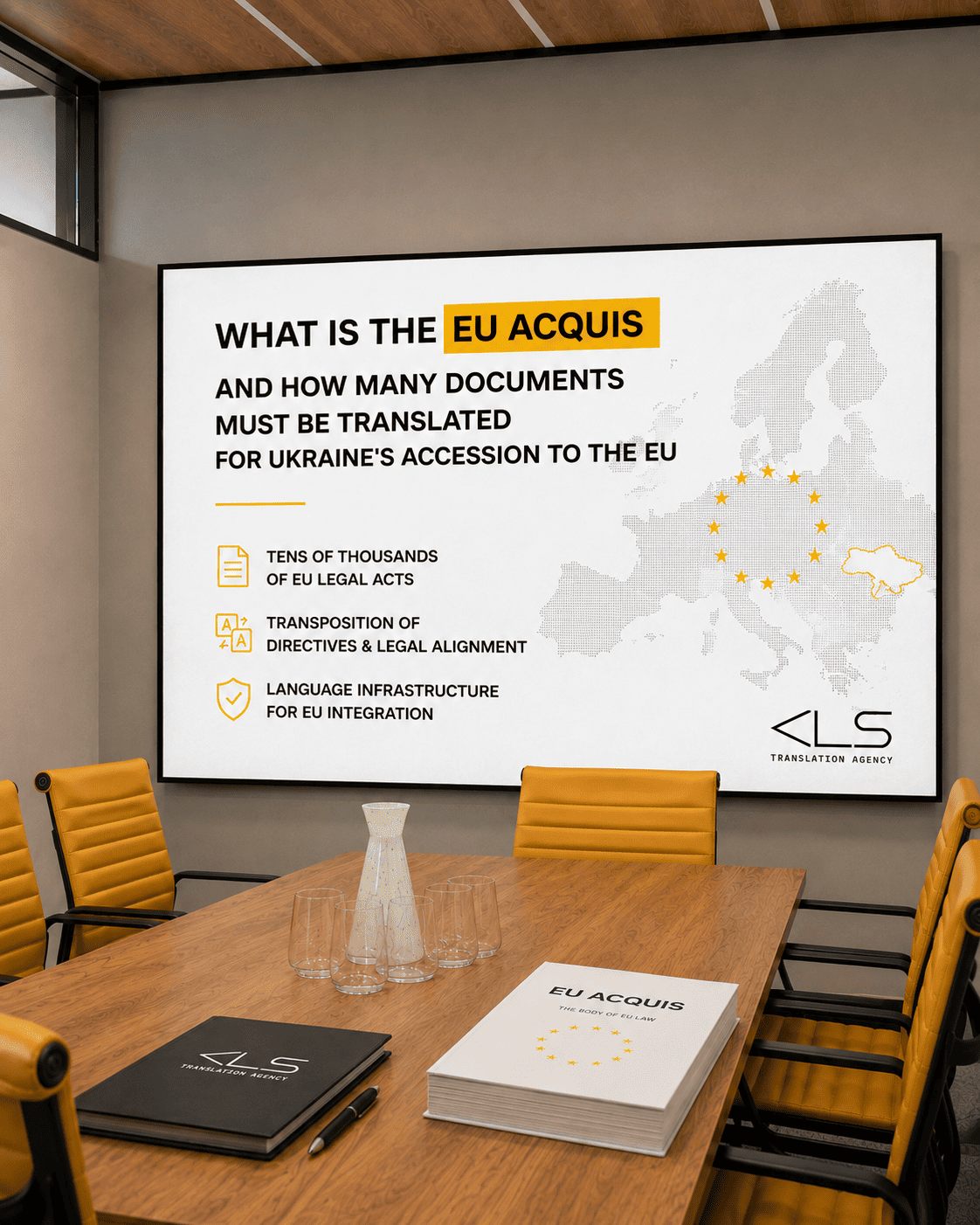
What is the EU acquis, and how many documents need to be translated for Ukraine's accession to the EU
When people discuss Ukraine's accession to the European Union, the conversation usually focuses on reforms, anti-corruption measures, and geopolitical decisions. The other significant part is less visible yet equally significant: translating, adapting, and implementing tens of thousands of EU legal acts into Ukrainian legislation.
So what exactly is the EU acquis, how extensive is it, and what does it mean in practice? The article provides a closer look at this.
What is the EU acquis?
The EU acquis, formally known as the acquis communautaire, is the body of EU law, legal acts, court decisions, international agreements, and legal obligations that are binding on all EU Member States.
Simply put, it is the complete set of rules that governs the European Union, from product standards and data protection to food safety, financial markets, labour law, and environmental policy.
To become an EU Member State, a candidate country must align its national legislation with the EU acquis by transposing EU legislation into domestic law. This process is the key part of the EU accession negotiations.
Number of required documents
The EU acquis comprises tens of thousands of legal acts, international agreements, judgments of the Court of Justice of the European Union (CJEU), and other legal documents. It continues to expand as EU legislation evolves.
It includes regulations that apply directly across all Member States, directives that must be transposed into national legislation, decisions, and recommendations.
For practical purposes, the negotiation process is organised into 35 chapters – clusters, covering different policy areas. For many negotiation chapters, specific opening benchmarks and closing benchmarks define what exactly Ukraine must do to open and close the chapter.
The negotiation process is taking place in stages according to the new EU enlargement methodology. Ukraine gradually undergoes legislation screening and opens negotiation chapters after fulfilling the conditions set by the European Commission.
What does “transposition” mean, and why it is more than just a translation
Transposing an EU directive goes far beyond a mere translation of its text into Ukrainian. It means integrating a legal norm into the national legal system while preserving its content, legal consequences, and terminological consistency with the original.
The difference matters for several critical reasons.
Terminological accuracy is a legal requirement. The EU acquis has its own developed terminological system, the “eurolect”, which has evolved over decades through the EU’s institutions in 24 official languages. Each term has a specific legal meaning, which may differ from its literal translation in a regular dictionary.
That is why, with the support of the Association4U project, the EU developed the first Ukrainian translation guide on translating the EU acquis in cooperation with four Ukrainian universities. EU legal translation is now recognized as a separate discipline with its own standards and terminology base by IATE.
Consistency between language versions. The EU regulation that enters into force is published simultaneously in 24 official languages, and every language version is legally authentic. When Ukraine transposes a directive, the Ukrainian version must be terminologically consistent with all other language versions. This is not a matter of style; it is a legal requirement.
Context interpretation. Successful transposition requires not only an understanding of the text, but also familiarity with how the legislation has been implemented in EU Member States, relevant judgments of the Court of Justice of the EU clarifying its content, and the guidance issued by the European Commission regarding proper implementation.
Which chapters are most relevant for business
Out of the 35 negotiating chapters, several have the most direct and immediate impact on Ukrainian companies.
Chapter 1: Free movement of goods. Technical regulations, standards, conformity assessment procedures, CE marking. The most operationally significant chapter for manufacturers.
Chapter 4: Free movement of capital. Investment rules, financial services, and investor protection.
Chapter 10: Information society and media. Digital market regulation, copyright, and personal data protection (GDPR).
Chapter 12: Food safety, veterinary and phytosanitary policy. Critical for the agri-food sector, one of the key sectors of the Ukrainian economy.
Chapter 15: Energy. Market liberalization, safety standards, and energy efficiency.
Chapters 23 and 24: Rule of law and fundamental rights. Judiciary, anti-corruption measures, protection of rights - the basis for progress in negotiations on all other chapters.
What role does the language infrastructure play in this process?
EU integration creates a continuous flow of documents that require accurate translation and terminological consistency.
At the government level, this includes: transposing EU directives into national legislation, preparing reports for the European Commission, and participating in accession negotiations.
At the business level, it’s necessary to: update technical documentation to comply with EU standards, adapt internal procedures to new regulatory requirements, and prepare compliance documentation for regulators, auditors, and business partners.
At the international level, language support includes translating and localising Ukraine's positions for international partners, translating documentation for EU-funded projects, and providing interpreting services during negotiations and official meetings.
Companies that start building the right language infrastructure today will be significantly better prepared for EU compliance than those that wait until the last moment.
Timeline and Realistic Expectations
Many analysts consider the period from 2030 to 2033 to be a realistic timeframe for Ukraine to join the EU. However, compliance with the EU acquis begins long before formal membership.
Each opened cluster has specific implementation deadlines. For certain sectors, transitional periods for implementing specific technical regulations are already approaching their deadlines in 2026, making immediate action vital.
European Commissioner for Enlargement Marta Kos expressed the political objective of opening all negotiation clusters with Ukraine by July 2026. This implies the accelerated pace and increased volume of transpositions work.
Integration into the EU does not wait for the accession date. It is happening now.
Conclusion
The EU acquis consists of tens of thousands of legal acts and standards that form the legal foundation of the European Union.
Transposing this array into Ukrainian legislation is the largest regulatory project in the history of Ukraine.
And every element of this process depends on language: accurate legal translation, consistent terminology, and certified document flow.
If your business is already preparing EU compliance documentation or plans to do so, KLS can help you build the right language infrastructure for your industry, regulatory requirements, and the scope of international operations.
Tens of thousands of legal acts, including regulations, directives, decisions, recommendations, and judgments of the Court of Justice of the EU. For practical purposes, the negotiation process is organized into 35 chapters.
As of early 2026, Ukraine has opened 18 of the 35 negotiation chapters, while technical preparations for opening additional chapters continue.
EU Commissioner for Enlargement Marta Cos has repeatedly stated the political goal of opening all negotiation clusters with Ukraine by mid-2026, provided that the necessary criteria are met.
EU legal translation is a specialised discipline. It requires knowledge of Eurolect, a specific terminology system of EU institutions, the IATE database, the principles of transposing directives, and the case law of the Court of Justice of the EU. A translator who knows Ukrainian civil law well will not necessarily translate EU regulations correctly.
For some industries, the answer is now. Implementation timelines for certain technical regulations end in 2026. Businesses that match their documentation with EU standards in advance will be able to enter the European market much faster than their competitors after concluding relevant agreements.
Yes. KLS professionally translates regulatory documentation, ensures terminology consistency through language versions, and has extensive experience supporting EU-funded projects and multilingual compliance documentation.