Machine Translation Post-Editing and ISO 18587:201 — What It Means for Your Business
Your Company Already Uses Machine Translation. The Question Is — Who Checks the Output
Most companies adopted machine translation not as a strategy — but as a practice that formed on its own. Someone copied text into DeepL to understand a partner's email. Someone enabled automatic translation in a corporate TMS. Someone connected a translation module to their CMS.
And that's fine. Machine translation solves real operational problems: speed, scale, cost.
But there is a question that often goes unanswered in this practice: who is accountable for the quality of what it produces?
Read also: Machine Translation Errors: Their Main Types and Solutions to Address Them
Where Machine Translation Delivers — and Where It Doesn't
Machine translation works well with uniform, structured content with a high degree of repetition: technical documentation with standard formulations, internal communications, large volumes where speed matters more than perfect style.
It starts to fail when content involves:
- Specialist terminology the model hasn't seen enough of during training
- Contextual ambiguity — the same word with different meanings depending on the sector
- Legal or financial precision where every term carries a specific legal meaning
- Cultural adaptation where a literal translation produces the right words and the wrong meaning
- Brand-specific terminology and tone of voice
This is where the real problem lies. Not "machine translation is bad." But: the company doesn't know exactly where it is making mistakes in their specific texts.
What Post-Editing Is — and Why It's a Separate Discipline
Machine Translation Post-Editing (MTPE) is not "fixing mistakes." It is a structured process of verifying and refining machine translation output by a qualified linguist.
The difference between "fixing mistakes" and MTPE is significant.
An editor who simply reads a machine translation and corrects obvious errors does not guarantee a systematic result. They may miss a terminological inconsistency that isn't a grammatical error. They may not notice that the same term has been translated differently in two separate places in the same document. They may correct the style while missing a factual error in the numbers.
A certified MTPE process to ISO 18587:2017 involves a systematic approach: accuracy verification, terminological consistency, style and tone of voice compliance, and a final review by an independent reviewer.
What ISO 18587:2017 Means for the Client
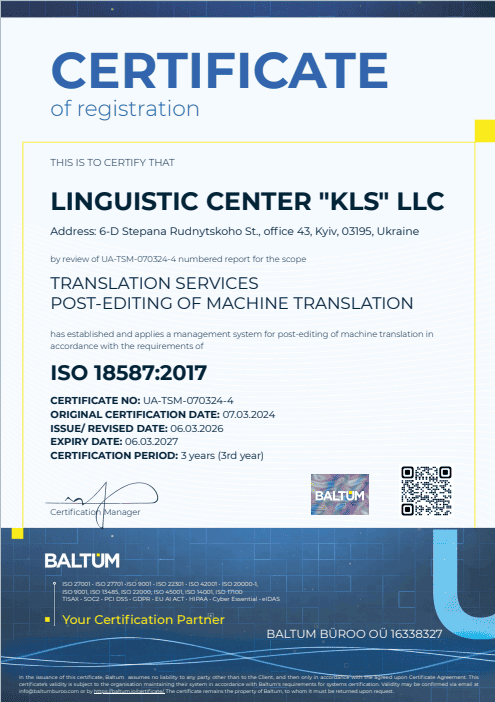
ISO 18587:2017 is the international standard for machine translation post-editing. It defines requirements for post-editor competencies, for the process and for the quality of the output.
KLS is certified to ISO 18587:2017. But what does this mean for the client — not as a fact, but as an operational reality?
First: a process, not personal skill
Without a standard, quality depends on a specific person on a specific day. With ISO 18587:2017, there is a documented process that every post-editor follows. The result is predictable regardless of who is performing the work this week.
Second: qualifications confirmed, not just declared
The standard defines specific competency requirements for post-editors: they must understand how machine translation works, know the typical patterns of its errors and be able to identify them systematically. This is a different skill from simply having a good command of the language.
Third: terminological consistency as a systemic requirement
The same term must be translated consistently across all documents in a project. ISO 18587:2017 includes working with the client's terminology bases — not just correcting the text in front of you.
Fourth: an audit trail
For compliance-sensitive sectors and corporate clients, what matters is not only that the output is of high quality — but that there is documented confirmation of the verification process. ISO 18587:2017 provides that audit trail.
Who Orders This Service and When
Corporate clients with their own corporate tools
A large company has an internal TMS or a connected translation module. Machine translation generates large volumes. But for critical documents — legal, financial, compliance — verification is required. KLS can work with the output from your corporate tool: you provide the machine translation, we verify and certify it.
Companies scaling into new markets
You need to prepare a large volume of content in multiple languages quickly. Machine translation provides the speed. MTPE from KLS gives you confidence that this content will not damage your reputation with a new audience.
IT and SaaS companies with large volumes of UI and documentation
Interface localisation, help centres, release notes — large volumes with repetitive terminology where machine translation is efficient but requires systematic verification and a terminology base.
Organisations working with EU compliance documentation
EU integration creates a continuous flow of regulatory documents. Machine translation helps handle large volumes of text, and verification certified to ISO 18587:2017 provides confidence that terminology aligns with official EU standards.
Two Levels of Post-Editing — and When Each Is Needed
Light post-editing Goal: make the text comprehensible and functional. Critical errors, terminological inconsistencies and major grammatical mistakes are corrected. Style and tone of voice are brought within acceptable range. Suitable for internal communications and informational content where speed is more important than perfection.
Full post-editing Goal: bring the text to a level indistinguishable from human translation. Full accuracy verification, terminological consistency, compliance with the client's style guide, final review by an independent reviewer. Suitable for public-facing content, legal and financial documents, marketing materials and compliance documentation.
Practical Conclusion
The question is not "whether to use machine translation." For most companies, practice has already answered that. The question is: how to organise the verification of what it generates — systematically, with a predictable result and the ability to demonstrate quality to an external auditor.
KLS's ISO 18587:2017 certified MTPE process is the answer to that question.
If your company already uses machine translation and wants to organise its systematic verification — talk to us. We work with the output from your corporate tool and adapt the process to your terminology base.
ISO 18587:2017 is the international standard for machine translation post-editing. It defines requirements for post-editor competencies and for the verification process. KLS is certified to this standard — meaning our MTPE process meets international requirements and provides an audit trail for compliance purposes.
Light post-editing corrects critical errors for functional comprehension. Full post-editing brings text to a level indistinguishable from human translation: complete accuracy verification, terminological consistency, compliance with the style guide. For public-facing and compliance documents, full post-editing is recommended.
Yes. We maintain client terminology bases and keep them up to date. This ensures terminological consistency across all project documents regardless of volume and time horizon.
When calculating the total cost for machine translation post-editing and/or post post-editing services, always take into account not only the volume and complexity of the material being edited, but also any match-es/repetitions that need addressing within the text. Doing so will ensure you receive an accurate estimate for your project’s total cost before beginning work with your chosen provider(s).