How language infrastructure supports international defense procurement, technical documentation, and negotiations between Ukraine and European partners
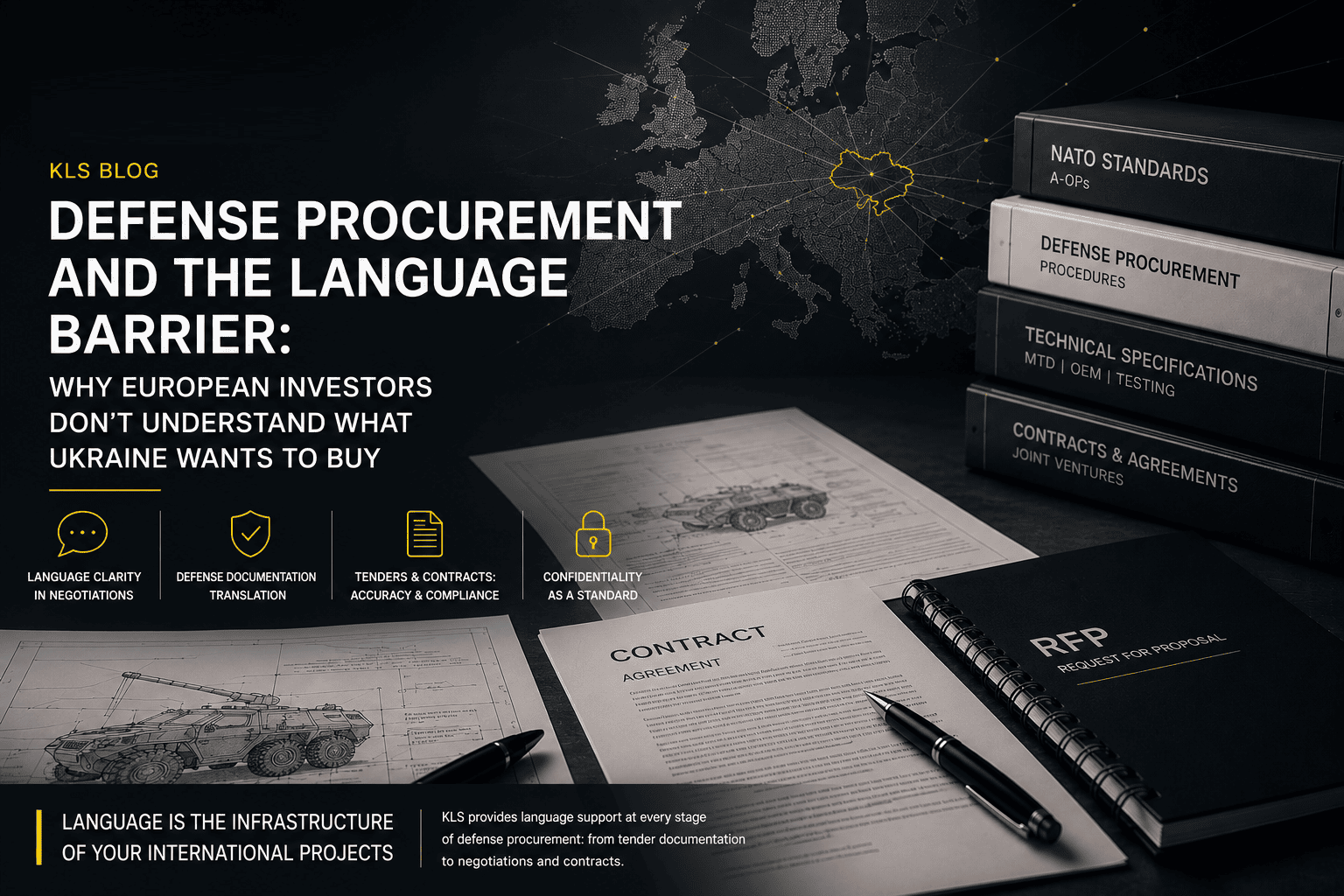
Defense Procurement and the Language Problem: Why European Investors Don't Understand What Ukraine Wants to Buy
In December 2025, the RAND Corporation published a detailed report on the obstacles to European-Ukrainian defense cooperation. Among the key findings are two that directly relate to communication:
European investors find procurement processes in Ukraine uncoordinated, which makes them uncertain about what Ukraine wants to buy and produce in cooperation with partners.
The issue, however, is not only in financing or technology, but also in the lack of clear communication between the Ukrainian defense procurement system and potential European partners. At the heart of the communication problem is the language and terminology gap between the Ukrainian defense system and European stakeholders.
The problem becomes critical as the projects scale
To understand why this problem is important, consider several figures.
At the beginning of the war, Ukraine’s annual defense production capacity was estimated at $1 billion. By June 2025, President Zelensky reported that it had exceeded $35 billion. But about 40% of this potential is not properly funded.
The gap between what Ukraine can produce and what it can purchase is gigantic. Therefore, attracting foreign capital and partnerships becomes a strategic priority.
At the same time, Ukraine has become an associated country of the European Defense Fund (EDF). The EU is investing €910 million in defense innovation. The "Danish model" of direct funding is scaling up and attracting new donors.
But practical barriers, including unclear procurement processes and a communication gap, are holding back much of the potential collaboration.
Where exactly does the communication breakdown hide?
Problem 1: Procurement requirements are not formulated in a language that the foreign partner can understand
The Ukrainian defense procurement system has its own terminology, procedures, and logic, shaped over decades and adapted to wartime conditions. A foreign company trying to enter this market for the first time faces not only a language barrier but also the need to interpret procurement requirements in a context it does not understand.
The result is what RAND describes as "uncertainty about what Ukraine wants to buy and produce."
Problem 2: Technical documentation exists only in Ukrainian
Technical specifications, product requirements, testing and certification standards, all of this often exists only in Ukrainian versions. A foreign company considering the possibility of joint production or supply cannot assess the compliance of its products with the requirements without a high-quality translation with an understanding of the subject area.
Translation of defense technical documentation is different from general legal or technical translation. It is a separate discipline with its own terminology base: NATO standards, military-technical specifications, and procurement procedures of international defense organizations.
Problem 3: Negotiations between different defense procurement systems
The Ukrainian and European defense procurement systems have different decision-making logics, different negotiation formats, and different expectations from partners. Polish Foreign Minister Sikorski bluntly called procurement coordination a matter of "a change of mentality."
This change of mentality requires not only goodwill; it requires skilled linguistic and cultural mediation in negotiations.
Problem 4: Intellectual Property, Export Control, and Contract Documentation
Joint ventures (initiatives) and licensing agreements in the defense sector require precise processing of intellectual property, export control, and contract documentation issues, both in Ukrainian and foreign legal systems. Any terminological discrepancy between contract versions is a potential subject of dispute.
What makes this aspect critical right now
At the end of 2025, the EU continued the implementation of the ReArm Europe / Readiness 2030 initiative, aimed at increasing defense investments and developing the European defense industry.
This means that the window for European companies to enter the Ukrainian defense ecosystem is opening more actively than ever. Companies that can effectively introduce their proposals and understand Ukrainian requirements will have an advantage.
But this requires infrastructure. Not only legal and financial, but also linguistic.
What does a "language infrastructure partner" mean in the context of defense
Such a partner does much more than just a translator who receives a document and returns it in the required language. This partner understands the specifics of defense procurement and provides a communication infrastructure for complex international contacts.
Translation of technical and procurement documentation. Understanding of the subject area: NATO standards, technical specifications, certification requirements. Terminological accuracy is not an option, but a necessary condition for the document to be accepted.
Simultaneous and consecutive translation of negotiations. Multilateral negotiations between Ukrainian and foreign representatives of the defense industry, with an understanding of the context, protocol, and terminology used in this environment.
Legal and contractual documentation. Joint ventures, license agreements, NDAs, and procurement contracts in agreed versions must be submitted in two languages, ensuring terminological and legal compliance.
Confidentiality as an operational standard. Defense projects require the highest level of information security. A secure document transfer infrastructure, strict NDAs, and verified suppliers with experience working with confidential information are a basic requirement.
KLS and the defense sector
KLS has proven experience working with projects in the defense sector. Details are under NDA, but general information is available:
- Our translators are professionals with a specialized terminology base and the understanding of the technical, legal, and procurement context.
- We have proven processes for handling confidential information, from secure document transfer to clear access restrictions within the team.
- We have experience in simultaneous interpretation at negotiations where accuracy and confidentiality are critical parameters.
If your Ukrainian or foreign company needs a language partner in defense procurement, negotiations, technical documentation, contract, or tender support, we are ready to talk.
The first conversation is without an NDA. The rest of the cooperation is covered by the NDA from the first document.
Yes. We have well-established processes for working with confidential information: secure document transfer channels, strict NDAs, and controlled access within the team. We will discuss the details at the first meeting.
The primary language combinations for this sector are: Ukrainian ↔ English, Ukrainian ↔ Polish, Ukrainian ↔ French, and Ukrainian ↔ German. If necessary, other languages are also available with the involvement of specialized experts.
Yes. Our translators have experience working with the relevant terminology base. Details of specific projects are under NDA.
Yes. Including closed formats where confidentiality is a key requirement.