A Simultaneous Interpretation School from KLS
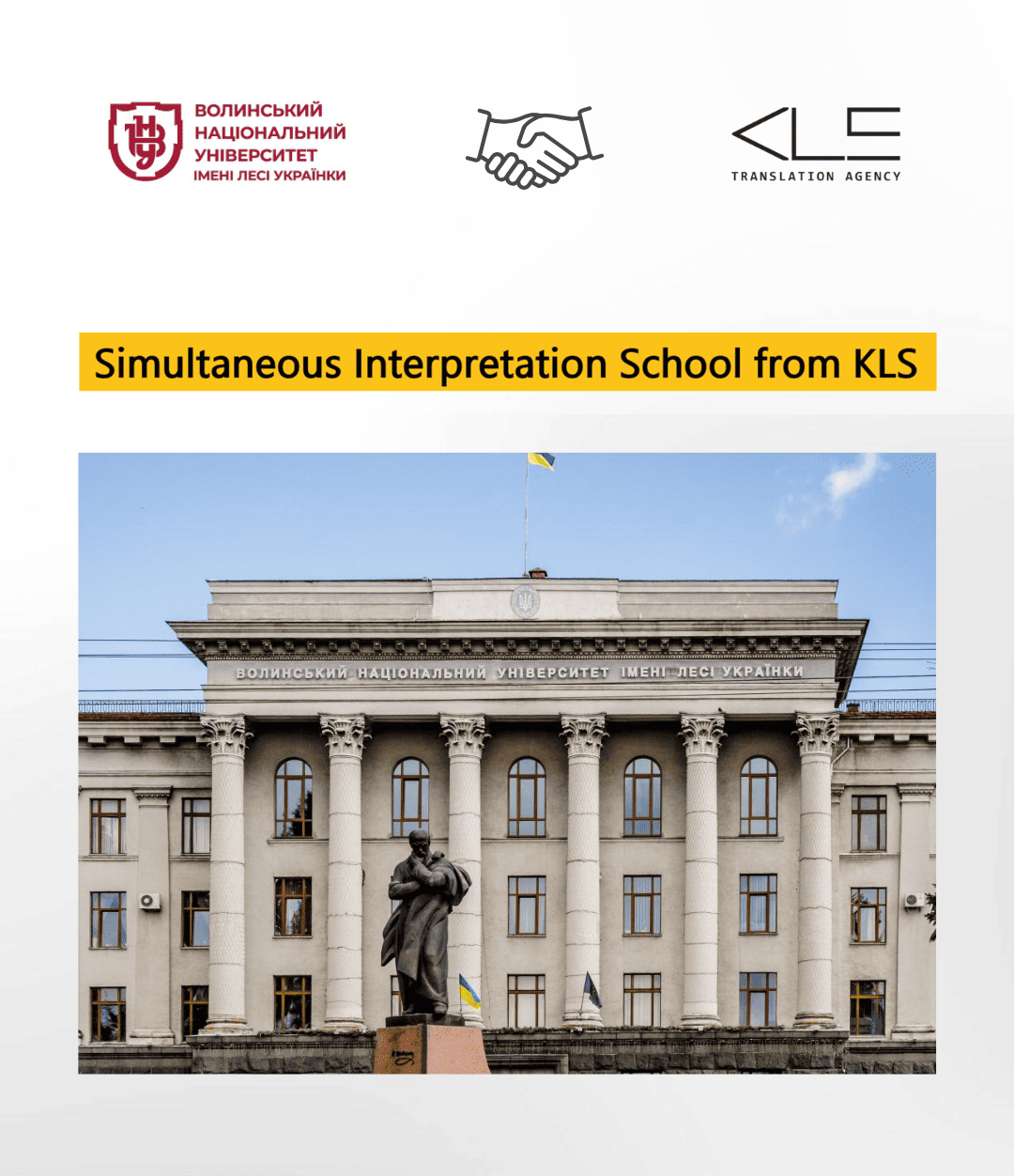
A Simultaneous Interpretation School from KLS
What does the KLS Agency team do when they have free time?
Of course, they help future interpreters master practical skills and professional life hacks.
As soon as we learned that, at Lesia Ukrainka Volyn National University, in its Foreign Philology Faculty, there was a specialized multimedia laboratory for teaching simultaneous interpretation we certainly could not stay on the sidelines.
Our colleagues supported this volunteer undertaking:
“Thank you for the offer, I’m willing to help colleagues and brothers and sisters in the cause from Volyn”, such was the response from Ostap Zdorovylo, our simultaneous interpreter with extensive practice.
Last year, we joined a similar skill-building initiative for professionals, and we deem it important that such projects continue to develop.
So, let’s have a glance at how things evolved there and what secrets our maestros of simultaneous interpretation revealed at their lectures.
Why do we make a contribution?
Our goal is indeed both simple and ambitious: we want to merge interpretation teaching with things happening in real life.
The modern markets are extremely dynamic as new formats and tools are appearing all the time and customer expectations are evolving. What was yesterday an addition or simply a desirable option is now becoming the standard. Therefore, practical experience becomes crucial as a necessary follow-up of theoretical knowledge.
This project means much more for us than just delivering several lectures.
- We share experience gained over years of work in the booth, at conferences, and in negotiations.
- It is about life hacks from pure practice that textbooks rarely mention: how to respond to unexpected changes made by the speaker, how to keep pace, how to work in pairs, how to avoid losing sense when time is pressing you down.
- And it is also a social responsibility for us. Every experienced interpreter remembers well their first days in the profession, when knowledge seemed to be enough, but an understanding of how it really should work was just starting to evolve. Hence, it’s crucial for us to support people starting their journey.
It is a volunteer project and for us its value is far from being purely commercial. Its importance stems from the fact that, by becoming engaged in it, we contribute to the development of the interpretation sector as a whole.
The School’s First Days: What Has Been Discussed So Far?
This year, the School is held between 4 and 8 May.
- The first day has started by discussing the topic of ongoing professional development, which people often underestimate in the beginning of their careers.
Khrystyna Skorenka talked about CPD (Continuous Professional Development) for an interpreter working with two languages. Her lecture did not tackle training courses and certificates only, as she spoke about a structured approach to development: how to choose work areas, how to stay focused on what truly matters, and how to shape one’s own expertise.
- The second day was highly practical and, judging from the students’ response, of a special value for them.
Yaroslava Lukina talked about distance interpretation and platforms for online work. This topic has recently become part and parcel of the profession. However, the tool list is not the key, as much more important is to understand how they work in real life.
This session enabled students, among other things, to learn how to best prepare for an event and do a short role-play. They had an opportunity to have a palpable sense of the process dynamics, step into the role of interpreter, face the first challenges and immediately discuss them.
- Here is Yaroslava’s feedback,
“I believe everything went well. The participants were active and asked questions. We had time to try and complete a practical task of interpreting from English into Ukrainian and share experiences; questions were also asked about platforms and headsets”.
Real-life practice and genuine engagement are the best evidence proving how interesting and necessary these learning formats are. They demonstrate the essence of the profession, the most acute questions rise and are addressed there, and nuances come to light that you may discover only if you do the work yourself.
- In the afternoon, Ostap Zdorovylo shared his knowledge of how an interpreter should search for clients and develop cooperation with agencies.
Although this topic is rarely taught at universities, it is of exceptional importance for professional development.
More to come soon!
Our school continues, and the third day lies ahead — May 8th.
On this day, we will talk about strategies to overcome interpretation challenges and the ethical aspects of simultaneous interpretation. It seems that these topics will be a natural continuation of the discussion about the profession where the nexus linking techniques and skills with responsibility and trust is obvious.
After all, in addition to a perfect language command and the ability to quickly reproduce what the speaker says, the interpreter must interact effectively with clients and colleagues and not get lost if things go wrong.
There is a point in every professional’s journey when passing on acquired expertise becomes both a need and a possibility.
We at KLS are happy as we possess a lot of useful knowledge and practices that the next generation of interpreters and translators may capitalize on. And we are also grateful for an opportunity to be engaged in such projects, which have become a well-established tradition for KLS.